Agentic AI: What It Actually Means and Why Most Implementations Miss the Point
Beyond the hype of autonomous agents - what actually makes agentic systems work in production and where they fail
On this page
Everyone is building agents right now. Every AI startup has an agent. Every enterprise AI initiative has an agent in its roadmap. And most of the demos are impressive in a controlled environment and break in interesting ways in the real world.
I’ve built agentic AI systems at Microsoft with enterprise clients across healthcare, retail, and financial services. Here’s what I’ve learned about what actually works and what doesn’t.
What agentic AI actually means
An AI agent is a system where a language model can take actions in the world - not just answer questions but actually do things. It can search the web, call APIs, write and execute code, interact with external services, and use the results of those actions to decide what to do next.
An agent is not magic. It’s an LLM in a loop with access to tools. Understanding this makes building them a lot less mysterious.
Stripped of frameworks, the loop is almost embarrassingly simple:
# The whole thing, on one screen.
state = {"goal": user_goal, "history": []}

while not done(state):
    decision = llm.choose_action(state, tools=TOOLS)  # "which tool, what args?"
    if decision.is_final:
        return decision.answer

    observation = TOOLS[decision.tool].run(decision.args)  # do the thing
    state["history"].append((decision, observation))       # remember it
Everything hard about agentic AI — reliability, scope, recovery, evals — lives around those ten lines, not inside them.
Where most agent implementations fail
Reliability and error handling
LLMs are probabilistic. They don’t always call the right tool. They don’t always format parameters correctly. They sometimes get stuck in loops. Most demo agents work 80% of the time - which is impressive for a demo and completely unacceptable for a production system that’s taking real actions in the real world. I go through the specific failure modes and recovery patterns in Building Your First Agentic System.
Scope control
An agent that can do too many things is a liability. The right approach is to start with narrow tool sets and expand scope gradually as reliability is proven.
What makes agents actually work in production
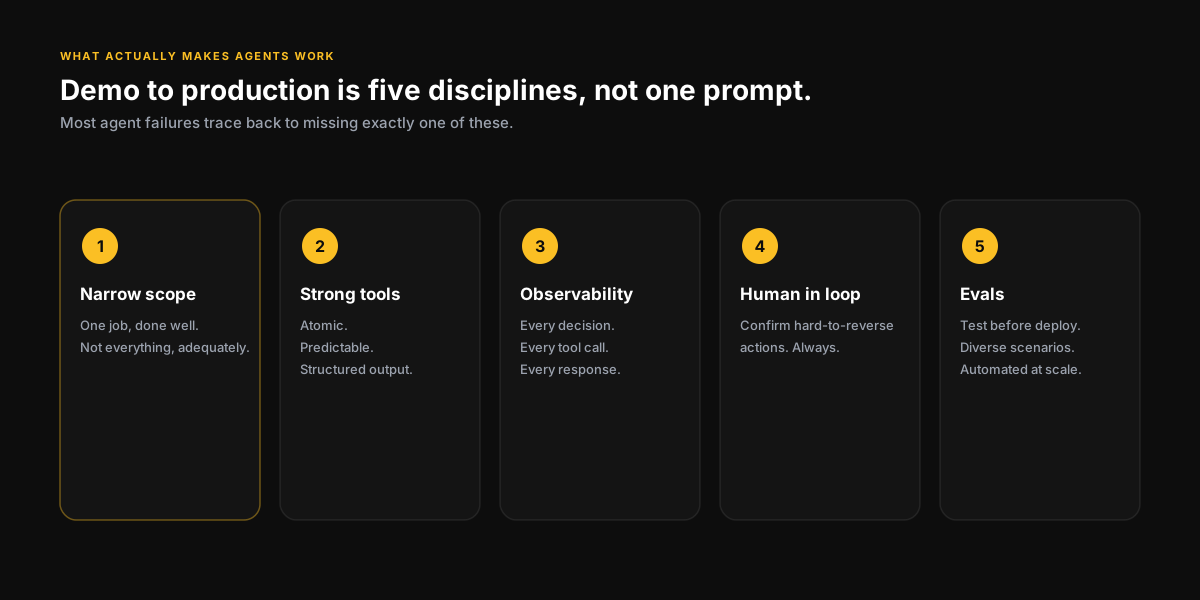
- Clear, narrow task scope - the best production agents do one thing well, not everything adequately
- Strong tool design - tools that are simple, predictable, and return clean structured responses
- Observability - you need to see exactly what the agent decided, which tools it called, and what it got back
- Human-in-the-loop for high-stakes actions - any agent taking actions that are hard to reverse should have a confirmation step
- Evaluation infrastructure - you need a way to test agents across a diverse set of scenarios before deploying, which is where prompt engineering as a real craft starts to pay for itself
If you’re building an agentic AI system or evaluating whether agents are the right approach for your use case, I’d love to dig into it with you. This is exactly the kind of architecture question I work through in advisory sessions.
Book a SessionKeep reading
Building Your First Agentic System: What Nobody Tells You Before You Start
The real challenges of building multi-step AI agents, from tool use to error handling to latency, and why most first attempts break exactly where the demos look flawless.
8 min readPrompt Engineering is a Real Skill: Here's What Actually Makes a Good Prompt
The difference between a prompt that works in a demo and one that works in production is not magic. It's a learnable craft with clear principles.
7 min readFiled under
Previous
Building in Public as an Immigrant Founder: Why Visibility Is a Strategy, Not Just a Habit
Next
Real-Time Data Streaming: Why Batch Is No Longer Enough
Want to talk through this?
Book a session and let's get into your specific situation. No slides, no fluff.