RAG vs Fine-Tuning: How to Actually Decide
A decision framework for when to use retrieval vs. when to actually train, from someone who has built both
On this page
Every week someone asks me some version of the same question: “Should we do RAG or fine-tuning?” And every week I give the same first answer: it depends on what problem you’re actually trying to solve.
I’ve built both in production - RAG pipelines serving real-time document retrieval for enterprise clients, and fine-tuned models deployed for domain-specific classification and generation tasks. They are not in competition. They solve different problems. And more often than not, the real leverage is upstream of both of them — in your data layer.
The core distinction
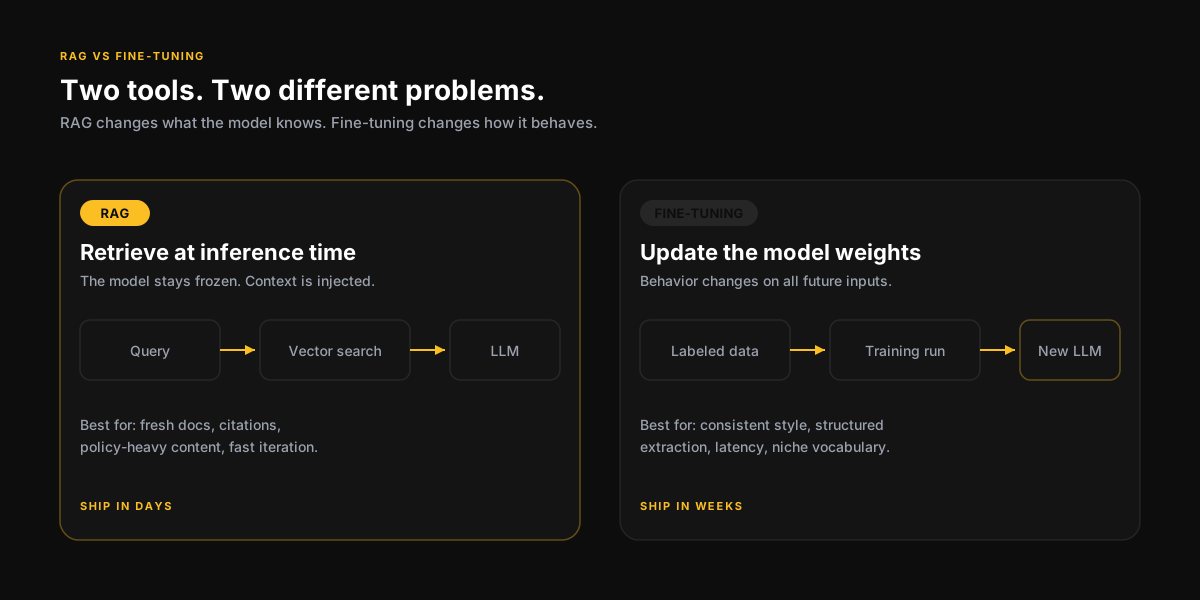
RAG (Retrieval-Augmented Generation) adds knowledge to a model at inference time. You retrieve relevant context from an external source and inject it into the prompt. The model doesn’t change - the input does.
Fine-tuning changes the model itself. You train on new data and update the model’s weights so that it behaves differently on all future inputs - even without any retrieval happening.
RAG changes what the model knows. Fine-tuning changes how the model behaves. Most people confuse the two and end up solving the wrong problem expensively.
When RAG is the right answer
- Your knowledge base changes frequently - documents, policies, product information that needs to stay current without retraining
- You need the model to cite sources - RAG gives you traceable, retrievable context that supports attribution
- You have a large, heterogeneous corpus - internal documentation, support tickets, research papers that a model can’t be trained on efficiently
- You need to ship fast - a working RAG system can be built in days; fine-tuning a custom model takes weeks
- Your knowledge is sensitive - keeping data in a retrieval layer with access controls is easier to secure than baking it into model weights
When fine-tuning is the right answer
- You need consistent style, tone, or format that retrieval can’t reliably enforce across thousands of outputs
- You’re classifying or extracting structured information from text - fine-tuned models outperform RAG on these tasks
- Latency is critical and you can’t afford the overhead of retrieval at inference time
- Your task is highly specialized with domain-specific vocabulary where base models consistently underperform
- You have high-quality labeled training data and the resources to run the training pipeline properly
The combination case
The most powerful setups I’ve built combine both. A fine-tuned model that understands your domain’s specific format and vocabulary, augmented with RAG to bring in fresh, contextual knowledge at inference time. This requires more engineering overhead to set up and maintain, but for the right use case, the performance is substantially better than either approach alone.
The questions to ask before you decide
- Is this a knowledge problem or a behavior problem? Knowledge = RAG. Behavior = fine-tuning.
- How often does the underlying information change? Frequently changing data argues strongly for RAG.
- What is your latency budget? Fine-tuned models are generally faster than retrieval-augmented pipelines.
- Do you have labeled training data? Fine-tuning without good data creates a worse model, not a better one.
- What is the cost of a wrong answer? High-stakes outputs with citation requirements need RAG’s traceability.
If you want this as a flowchart you can walk down on a whiteboard:
                  ┌───────────────────────────────────┐
                  │ Is the problem KNOWLEDGE or STYLE? │
                  └───────────────┬───────────────────┘
                                  │
                 ┌────────────────┴────────────────┐
                 ▼                                 ▼
           knowledge                        behavior / format
                 │                                 │
                 ▼                                 ▼
    ┌──────────────────────┐           ┌────────────────────────┐
    │ Does it change often?│           │ Have labeled examples? │
    └──────────┬───────────┘           └────────────┬───────────┘
          yes  │  no                         yes    │   no
               ▼                                    ▼
             RAG                             Fine-tune
     (cite sources, ship fast)          (consistent tone & shape)
                                                    │
                                                    ▼
                                             still struggling?
                                             → Fine-tune + RAG
In my experience, most teams that think they need fine-tuning actually need a better prompt and a cleaner retrieval layer first.
If you’re trying to make this decision for a specific product or system and want a second opinion from someone who has built both at scale, I’d love to dig into it with you.
Book a SessionKeep reading
Prompt Engineering is a Real Skill: Here's What Actually Makes a Good Prompt
The difference between a prompt that works in a demo and one that works in production is not magic. It's a learnable craft with clear principles.
7 min readThe Intersection of Data Engineering and AI
Why data engineering is the unsung backbone of every successful AI initiative and what it means for the next generation of builders.
6 min readFiled under
Previous
How I'd Break Into Data Engineering in 2025 If I Were Starting Over
Next
Building Your First Agentic System: What Nobody Tells You Before You Start
Want to talk through this?
Book a session and let's get into your specific situation. No slides, no fluff.